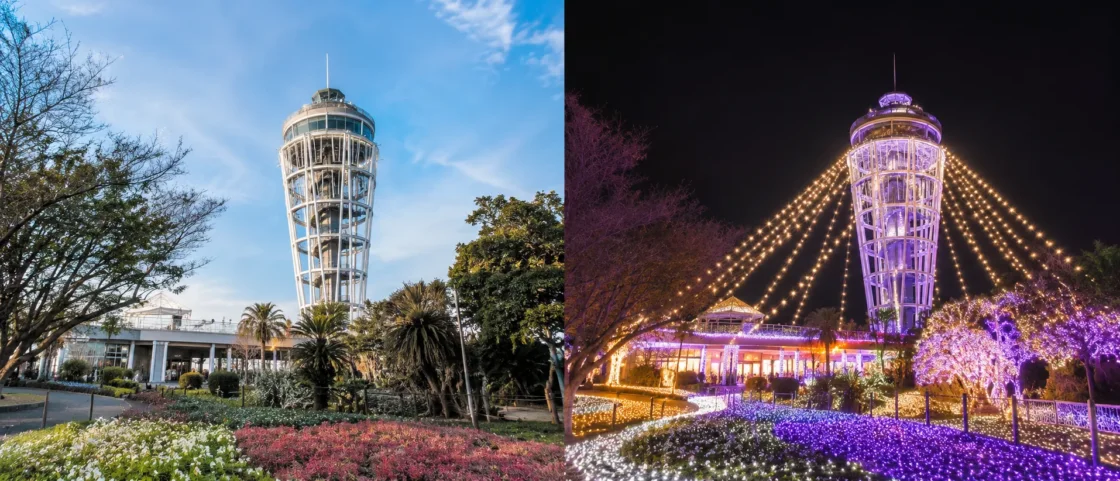
Shonan no Hoseki (湘南の宝石), meaning “Jewels of Shonan,” transforms Enoshima Island and the nearby Katase Beach area of Fujisawa, Japan, into a winter illumination destination. The main display surrounds Enoshima Sea Candle and Samuel Cocking Garden, where suspended light strands, illuminated plants, crystal-like installations, and a chandelier-lined tunnel form the central attraction. The lights remain on throughout the scheduled evening hours, so visitors can walk among the installations rather than wait for a short, repeated performance.
Shonan no Hoseki Lighting Schedule
No regular schedule is currently listed.
All listed times follow Japan Standard Time (JST). The main garden has a last-admission cutoff before closing, while some satellite installations operate on separate schedules.
When the Enoshima Illuminations Turn On
The principal lighting area is Enoshima Samuel Cocking Garden, at the top of the island. Its evening illumination includes Enoshima Sea Candle, the surrounding Grand Illumination, the Shonan Chandelier tunnel, and several smaller installations. These attractions share the main garden’s lighting period rather than running as individually timed shows.
The show is scheduled from Winter 2026 through 27. Detailed official hours TBA as of September 25, 2026.
The daily switch-on is particularly interesting around Enoshima Sea Candle. Visitors can gather near the tower before illumination begins and watch its suspended strands of light and the surrounding garden lighting turn on. The official event program identifies the Sea Candle’s main lighting area as the daily countdown location.
Why Lighting Times Change During Winter
Shonan no Hoseki uses different evening schedules for ordinary weekdays, weekends, public holidays, and selected holiday periods. The switch-on time also shifts later during the second half of the winter season. This adjustment follows the changing sunset period, while the closing time continues to depend on the applicable day’s schedule.
Arriving at the published lighting start allows you to see the switch-on, but arriving after dark provides a different viewing experience: the surrounding sky is darker, making the overhead light strands and ground-level installations more distinct. Those interested in both the sunset and illumination can reach the island summit earlier in the afternoon.
The Garden and Other Enoshima Venues Have Different Hours
The festival extends beyond Samuel Cocking Garden. Illuminated locations include Enoshima’s shrine areas, public squares, bridges, coastal streets, and certain participating attractions. Most of the outdoor island installations follow the principal evening lighting pattern, but selected facilities have independent opening periods.
Enoshima Iwaya Cave Has Different Hours
The illuminated Second Iwaya Cave is part of the festival program, but its lighting is associated with the cave’s daytime visiting hours. It should not be treated as another evening display operating until Samuel Cocking Garden closes.
Seasonal installations at Enoshima Yacht Harbor, the Shin-Enoshima Aquarium area, and Kugenuma Seaside Park may also run for shorter portions of the festival. The main garden remains the central location for visitors planning an evening specifically around the illuminations.
The Sea Candle’s Canopy of Lights
The most recognizable installation is Hikari no Daikukan, or the Grand Space of Light, surrounding Enoshima Sea Candle. Numerous strands of lights extend outward and downward from the observation tower, creating a canopy above part of Samuel Cocking Garden. Below it, the Grand Illumination covers the garden landscape with densely arranged points of light.
The arrangement can be viewed from different positions within the garden. From near the tower, the suspended strands dominate the scene; from farther back, the illuminated tower and the broad spread of lights become part of the same view. Visitors interested in photography can capture both arrangements without needing to climb the observation tower.
Shonan Chandelier and the Garden Entrance
The Shonan Chandelier (湘南シャンデリア) is a walk-through light tunnel containing large suspended chandeliers. Its concentrated lighting creates a different visual pattern from the open space surrounding Sea Candle. Rather than viewing the installation only from outside, visitors can walk through its illuminated interior.
The Shonan no Hoseki Entrance has a separate chandelier-centered arrangement, surrounded by closely spaced jewel-like lights. For the 2026–2027 edition, the entrance design features added visual depth and a more extensive starry-sky lighting effect.
Hoseki Forest, Seasonal Colors, and Art Installations
Hoseki Forest (ホウセキFOREST) takes a smaller-scale approach to the event’s lighting. Its installations combine LED jewel lights with terrariums, driftwood, and garden materials. According to the event organizer, the low-power LED system uses approximately one-third of the electricity required by its previous lighting arrangement.
The 2026–2027 program also features installations created by MIRRORBOWLER, an art collective known for reflective and light-based objects. These works introduce sculptural forms alongside the permanent garden setting and the tower’s more extensive illumination.
Another feature of this edition is Seasonal Jewel Lights. Selected portions of the entrance and ground illuminations receive limited-period color treatments associated with Christmas and Valentine’s Day. Green and pink are among the special color themes, so the appearance of parts of the display can differ depending on the visit date.
Illuminations Beyond Samuel Cocking Garden
Several locations across Enoshima extend the festival into the island’s streets and public spaces:
- Nakatsumiya Square: A mid-island illumination area with a viewing deck overlooking Enoshima Yacht Harbor and the surrounding coast.
- Kamegaoka Square: The Hoseki Square and SAKURA Illumination area near Samuel Cocking Garden, where early-blooming cherry blossoms may appear during the later part of the festival.
- Oiwado Road: The illuminated enoshima Hikari-michi walking route leading toward the Dragon Love Bell.
- Ryuren no Kane: The Dragon Love Bell on Lovers’ Hill, where decorative lights surround a landmark associated with Enoshima’s local romantic tradition.
- Enoshima Benten Bridge and the coastal approach: Lighting on bridges, trees, and selected public spaces connects the island with the Katase shoreline.
These smaller locations offer a different perspective from the Sea Candle installations. Instead of a concentrated garden display, the lights become part of the island’s existing paths, shrine surroundings, coastal views, and public squares.
Getting to Samuel Cocking Garden
Shonan no Hoseki’s main venue is located at Enoshima Samuel Cocking Garden, 2-3-28 Enoshima, Fujisawa, Kanagawa Prefecture, Japan. The garden occupies the island’s upper area, so reaching it involves crossing Enoshima Benten Bridge and ascending through the island’s central approach.
The official venue provides the following approximate walking times from nearby railway stations, using the Enoshima Escar for the uphill portion:
| Railway Station | Line | Approximate Journey to Garden |
|---|---|---|
| Katase-Enoshima | Odakyu Enoshima Line | 20 minutes |
| Enoshima | Enoden Line | 25 minutes |
| Shonan-Enoshima | Shonan Monorail | 26 minutes |
From the bridge, continue through Benzaiten Nakamise Street toward the red torii gate near Enoshima Shrine. The entrance to Enoshima Escar is to the left of the gate. After completing the escalator sections, Samuel Cocking Garden is nearby.
Enoshima Escar and the Uphill Walk
Enoshima Escar is an outdoor escalator system divided into three uphill sections. It ascends approximately 46 meters in elevation over a ride of roughly four minutes, offering an alternative to climbing the island’s hillside steps.
The Escar operates uphill only. Visitors returning from the upper island normally descend using the pedestrian stairs and pathways. Its operating hours also differ from the illumination schedule, so an escalator ride should not be assumed to be available throughout the entire evening.
Anyone traveling with a stroller, using a mobility aid, or finding stairs difficult should consider the downhill journey as well as the ascent. The island’s sloping paths and stairways are an important part of planning a nighttime visit.
Garden Admission, Sea Candle Tickets, and Combination Passes
There are three separate paid facilities to distinguish: Samuel Cocking Garden during its ticketed evening period, the Enoshima Sea Candle observation tower, and Enoshima Escar. A garden ticket permits access to the illuminated garden but does not automatically include the observation tower or escalator.
The garden is ordinarily free to enter during the daytime. During ticketed evening events, however, remaining in the garden after the designated daytime cutoff requires the applicable night admission or a qualifying combination ticket. Entering before the evening period does not by itself provide free access to the nighttime display.
Visitors using all three facilities can consider the Enoshima Sea Candle Set Ticket + Night, a digital combination ticket covering Escar, Sea Candle, and the garden’s nighttime admission. Rail-inclusive versions are also offered through participating transportation ticket services.
Planning the Walk Around Sunset
A practical visit begins with the journey across Benten Bridge and up to the garden before the main lighting starts. This allows time to explore the summit, see the coastal views in daylight, and find a position near Sea Candle for the evening switch-on.
After the tower illumination begins, visitors can walk through the Shonan Chandelier and entrance installations, continue around the garden’s smaller displays, and then explore Kamegaoka Square or the illuminated paths toward other island landmarks. The full island route involves more walking than the main garden alone.
Evening Viewing Tip
For photographs that include both the Sea Candle tower and its canopy of suspended lights, leave enough time to move between the open garden viewpoints and the illuminated tunnel. A visit focused only on the garden requires less walking than a route extending to Lovers’ Hill or the island caves.
Winter evenings on Enoshima can be windy, especially near exposed viewpoints and coastal paths. Warm clothing and comfortable walking shoes are appropriate for a visit that involves standing outdoors and moving between installations. Event arrangements may also change in unfavorable weather.
Traveling by train is generally more convenient on busy evenings. Although paid parking is available around Enoshima and Katase Beach, the venue operator advises public transportation during crowded holiday and weekend periods.
Sources
- Enoshima Sea Candle — Official Shonan no Hoseki 2026–2027 Event, Illumination Locations, and Schedule
- Enoshima Electric Railway — Shonan no Hoseki 2026–2027 Event Announcement
- Enoshima Sea Candle and Samuel Cocking Garden — Official Admission and Ticket Information
- Enoshima Sea Candle — Official Access, Railway Stations, and Parking Information
- Enoshima Sea Candle — Enoshima Escar Facility Information