Tonight’s times
Venue local timeSchedule
Current published scheduleLocation
MapMap
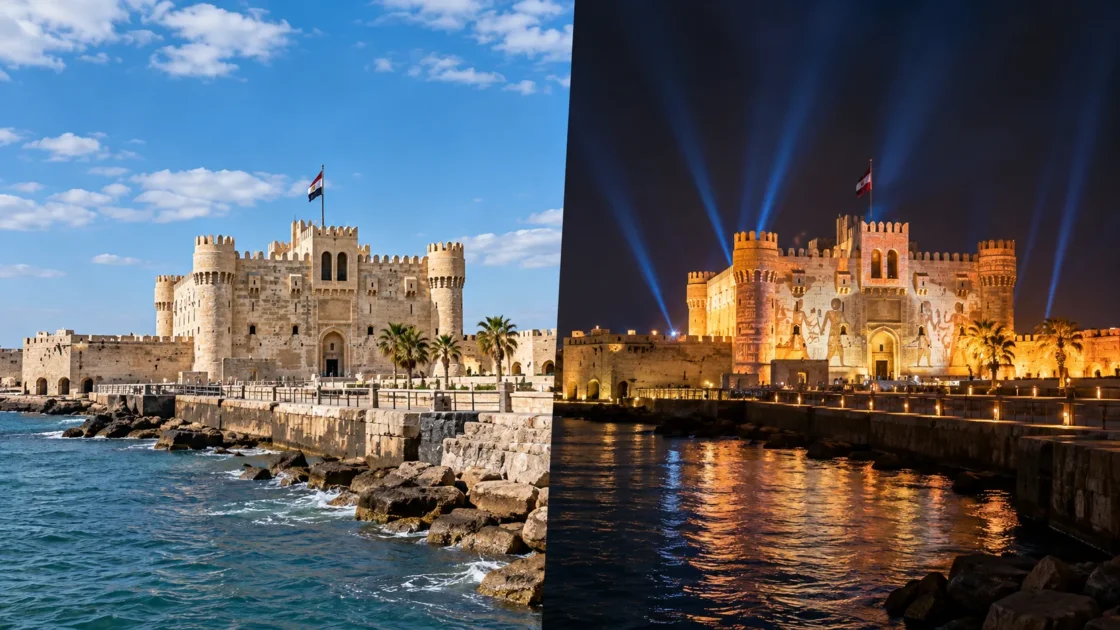
Qaitbay Citadel’s evening sound-and-light program turns the limestone fortress on Alexandria’s Mediterranean waterfront into the projection surface for a narrated history of the city. The show is separate from an ordinary daytime visit to the citadel, so its evening performance schedule is the important reference when planning a night visit.
Current Show Schedule
Daily, performances are scheduled at 8:30 PM and 9:30 PM.
How the Qaitbay Evening Program Works
The performance takes place at Qaitbay Citadel in Alexandria after the monument’s regular daytime visiting period. This distinction is useful when building an itinerary: seeing the fortress during the day and attending the sound-and-light show are different experiences rather than one continuous visit.
The operator lists more than one evening performance on its current program. It also notes that the first performance is held without a minimum audience requirement, while a later performance can depend on minimum attendance. That makes the earlier listed show the simpler choice when your plans depend on a specific evening.
The listed admission information is US$25 adult; US$14 child (6–12); US$30 VIP.
Language Note
The official show information lists Arabic and English and also provides translation devices under its stated visitor procedures. Foreign visitors using a translation device may be asked to present a valid passport, while accompanying tour guides have separate identification requirements.
Alexandria’s History Projected onto the Citadel
The fortress itself is part of the presentation. Images and lighting are projected across its stone architecture while narration follows different periods of Alexandria’s history. The program begins with the city’s foundation by Alexander the Great and moves through the Hellenistic, Roman, and Islamic periods.
Two vanished Alexandrian landmarks receive particular attention: the ancient Lighthouse of Alexandria and the ancient Library of Alexandria. The lighthouse connection is especially relevant here because Qaitbay Citadel was built in the fifteenth century on the site associated with the earlier Pharos lighthouse.
The historical narrative also includes figures connected with Alexandria’s past, including Cleopatra and Julius Caesar. Rather than presenting the citadel only as a backdrop, the projections use the surviving walls to connect the present-day monument with earlier phases of the city.
Why the Location Matters
Qaitbay Citadel stands in Alexandria’s Anfushi area on the site of ancient Pharos Island, with the Mediterranean surrounding the fort on three sides. Sultan al-Ashraf Qaitbay ordered its construction between 1477 and 1479 as part of Alexandria’s coastal defenses. Its outer walls, defensive towers, courtyard, and large central fort give the projections a very different physical setting from a conventional indoor screen.
Planning a Night at the Citadel
The citadel sits at the western side of Alexandria’s Eastern Harbour, so it can be combined naturally with time along the waterfront. For the evening show, plan around the performance entry rather than assuming that a daytime admission ticket covers the night program.
A daytime visit offers a closer look at the fortress before the projections begin after dark. The Ministry of Tourism and Antiquities describes an outer defensive wall with towers, an inner courtyard, rooms formerly used as barracks and storage, and a three-story main fort with semicircular corner towers.
Visitor Center Inside the Citadel
The citadel also has a visitor center inside a hall of the main tower. Its displays include Arabic-English information panels, maps, diagrams, material on Alexandria’s defensive fortifications, and a screen showing a film about the ancient lighthouse site. That context can be useful if the sound-and-light presentation prompts an interest in the history behind the projected scenes.
Because evening show arrangements and ticket categories can change independently of ordinary monument visiting hours, use the current schedule and admission information shown with the live show data when choosing a performance.