Schedule
Current published scheduleLocation
Street View & mapStreet View
Map
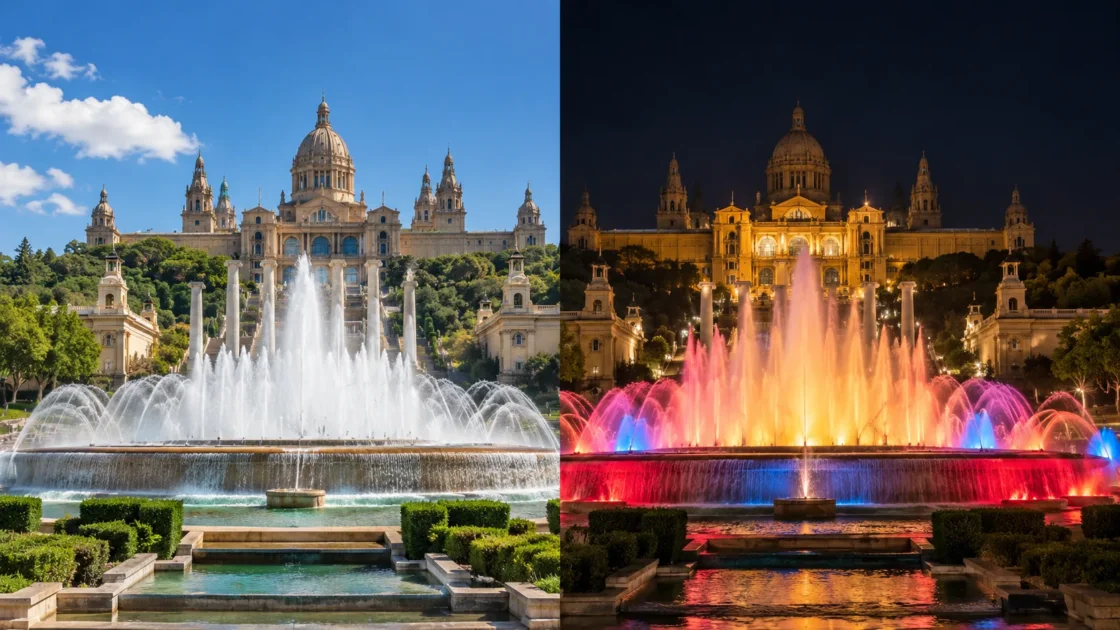
The Magic Fountain of Montjuïc sits on Barcelona’s monumental Montjuïc axis, between the Palau Nacional and Plaça d’Espanya. On programmed nights, the fountain combines moving water, colored light, and music, with the choreography forming part of a larger sequence of cascades, pools, and illuminated jets along Avinguda de la Reina Maria Cristina.
Current Show Pattern
From June 3 through September 27, Wednesday through Sunday, performances are scheduled at 9:30 PM and 10:00 PM.
Setting
Montjuïc, Barcelona
Designer
Carles Buïgas
Created For
1929 International Exhibition
Display
Water, Light, Color & Music
How the Fountain Program Runs
The Magic Fountain is not simply switched on as a static illuminated fountain for the entire evening. Its best-known performances are scheduled choreographies in which the movement of the water, changes in color, and recorded music are coordinated as one program.
That distinction is worth keeping in mind when planning a visit. The wider fountain installation can have an operating window, while the music-and-color choreography begins at specific listed points within that period. The current live schedule provides the relevant performance pattern rather than relying on an old seasonal timetable.
A performance lasts about 30 minutes.
Why the Calendar Changes
Barcelona adjusts the fountain timetable by season, with evening programs moving as daylight hours change. The number of operating nights can change as well. Special city events may also use the Montjuïc fountain complex differently from an ordinary performance night, so a festival program should not be assumed to match the normal fountain schedule.
The fountain returned to regular public performances after a major rehabilitation completed in 2025. The work renewed its control, sound, and lighting systems while retaining the historic installation designed around Carles Buïgas’s original fountain.
What Changes During the Display
The main basin is only one part of what you see. The Magic Fountain anchors an architectural line running downhill toward Plaça d’Espanya, with cascades, pools, and additional water features extending through the Montjuïc setting. During the programmed display, changing jet formations and colored illumination make the central fountain the visual focus.
Carles Buïgas designed the fountain for the 1929 International Exhibition in Barcelona. His concept treated water and electric lighting as coordinated visual elements rather than using illumination merely to light a conventional fountain. Music became part of the attraction in 1971, creating the water-light-and-sound format associated with the fountain today.
A Historic Fountain with Newer Controls
The installation has been altered and restored several times during its long operating life. More recent work replaced older lighting equipment with LED technology and modernized the systems used to control the fountain, lighting, and sound. The hydraulic character of the original design remains central to the performance.
The fountain also uses recycled water for its operation. That feature was introduced as part of earlier work intended to reduce the amount of drinking water required by the installation.
Programs are not restricted to a single musical style. The fountain has been used with classical music, popular music, film soundtracks, jazz, rock, rumba, seasonal selections, and event-specific programs. The soundtrack and choreography can therefore differ between program periods rather than functioning as one permanently repeated sequence.
Choosing a View Along the Montjuïc Axis
The fountain stands at Plaça de Carles Buïgas in front of the Palau Nacional, with Avinguda de la Reina Maria Cristina descending toward Plaça d’Espanya. That long, open layout gives you several ways to watch rather than a single designated viewing position.
Standing closer to the main basin makes individual water formations, lighting changes, and the central choreography easier to follow. Moving farther down the axis gives more room to see the fountain in relation to the surrounding cascades, avenue, and Palau Nacional. A side position can be useful if the central area is already busy, though the composition will naturally look different from there.
Arrival Tip
Allow enough walking time to reach Plaça de Carles Buïgas before the listed choreography begins. The fountain sits uphill from Plaça d’Espanya, and arriving exactly at the performance time can leave little opportunity to choose a comfortable viewing position.
Reaching the Fountain by Public Transport
Espanya is the main public-transport stop for this part of Montjuïc. Barcelona Metro lines L1 and L3 serve the station, along with FGC rail services. From Plaça d’Espanya, the approach follows the broad avenue toward the Palau Nacional and the fountain complex.
The official address is Plaça de Carles Buïgas, 1, Barcelona. Nearby attractions include the Museu Nacional d’Art de Catalunya, CaixaForum, Poble Espanyol, and other Montjuïc cultural and recreational sites, so the fountain can fit naturally into an evening already spent in this part of the city.
Because performances take place outdoors, conditions around the fountain can differ from one evening to another. Comfortable walking shoes are useful on the Montjuïc approaches, especially when combining the show with other places higher on the hill.