Tonight’s times
Venue local timeSchedule
Current published scheduleLocation
MapMap
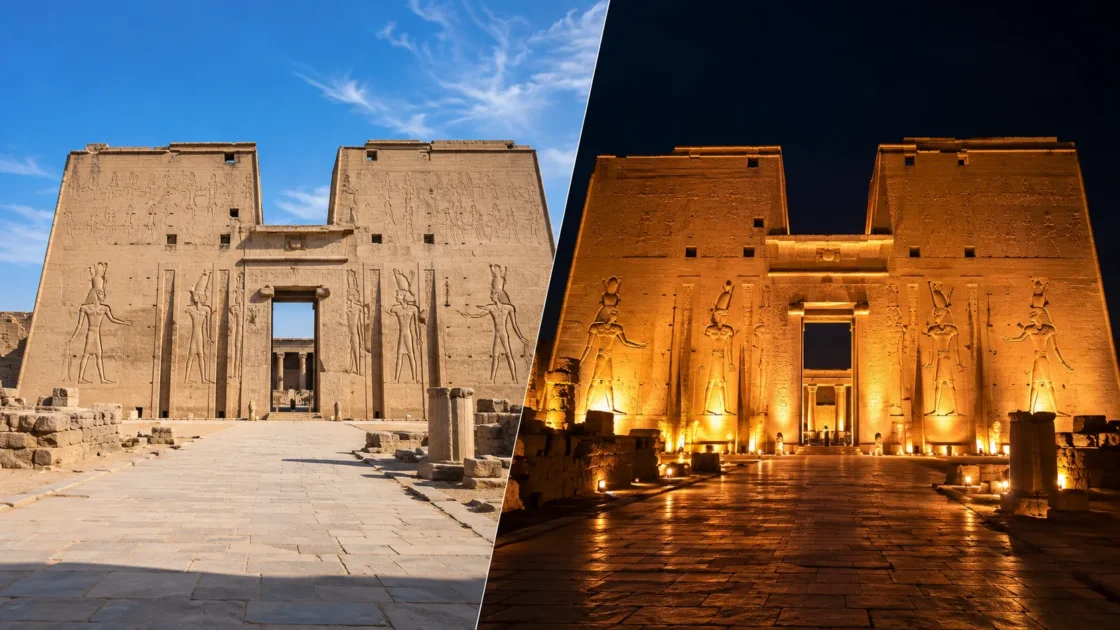
After daytime visits wind down, Edfu Temple becomes the setting for an evening sound-and-light program focused on Horus, the mythology recorded on the temple walls, and the monument’s Ptolemaic history. Colored illumination draws attention to the carved stone surfaces while narration connects the architecture with the story of Horus and Seth. Performance times can change, so the current timetable is more useful for planning than a permanently printed hour.
Current Show Pattern
Daily, performances are scheduled at 8:00 PM and 9:00 PM.
How the Edfu Evening Schedule Works
Edfu is operated as a scheduled evening show rather than continuous nighttime illumination. The exact performance pattern should therefore be matched to the date of your visit, especially if you are arranging the show around a daytime temple visit or other travel in the Nile Valley.
Second Show Booking Rule
The Sound & Light Company states that a second performance normally requires at least 6 foreign visitors or 10 Egyptian visitors. It also states that shows reserved in advance through its website are held without that minimum-attendance restriction.
This distinction matters most when choosing a later performance. A time may appear within the published program, but the operator’s attendance condition can affect how that second show is handled when there is no advance online booking. The company also notes that performance dates and schedules may change.
The evening timetable is separate from the archaeological site’s ordinary daytime opening hours. Use the Sound & Light schedule for the night program rather than assuming the temple’s daytime closing time determines when the performance begins.
What the Sound and Light Program Covers
The program is built around the Temple of Horus and stories connected with its religious setting. The operator describes the conflict between Horus and Seth as part of the narration, using light across the temple walls to accompany the historical and mythological material.
That setting gives the show more to work with than a single illuminated façade. Edfu retains monumental pylons, columned spaces, extensive inscriptions, reliefs, and representations of Horus. Lighting can isolate these architectural details after dark, making carvings that compete with bright daylight during a daytime visit easier to notice as individual visual elements.
Language and Narration
The official show information indicates that the Edfu production is offered for visitors using multiple languages. Language arrangements belong to the scheduled performance itself, so travelers who need a particular language should use the current booking information for their chosen date rather than relying on an older timetable.
Daytime Temple Visit vs. Evening Show
The Ministry of Tourism and Antiquities publishes regular visitor hours for Edfu Temple, while the Sound & Light Company publishes a separate evening program and its own show ticketing. Treat them as two different parts of a visit: daytime hours are intended for exploring the archaeological site, while the night program is a scheduled narrated production.
The Temple Behind the Evening Display
Edfu Temple stands on the west bank of the Nile and was dedicated to Horus. Construction began under Ptolemy III in 237 BC and was completed under Ptolemy XII in 57 BC, meaning the monument developed over roughly 180 years of the Ptolemaic period.
Its preservation is especially useful for a night production because so much of the architectural sequence remains readable. The entrance is dominated by two large pylons decorated with scenes of Ptolemy XII, with granite falcon statues representing Horus nearby. Beyond them are a columned court, two hypostyle halls, transverse spaces, and the sanctuary.
The carvings also connect directly with subjects used in the evening storytelling. The Ministry identifies scenes relating to the temple’s foundation and royal worship, while another hall includes imagery of Horus traveling in a sacred bark with Hathor. Seeing the monument in daylight first can therefore make some of the names, figures, and architectural spaces mentioned during the evening narration easier to place.
Planning the Same-Day Visit
- Plan the daytime archaeological visit and the evening performance as separate time blocks.
- Use the current show listing for the performance schedule rather than the temple’s normal visitor hours.
- Check the language attached to the performance you intend to book.
- Keep enough time between daytime sightseeing and the evening entry so the night program does not depend on a rushed return to the temple.