Tonight’s times
Venue local timeSchedule
Current published scheduleLocation
Street View & mapStreet View
Map
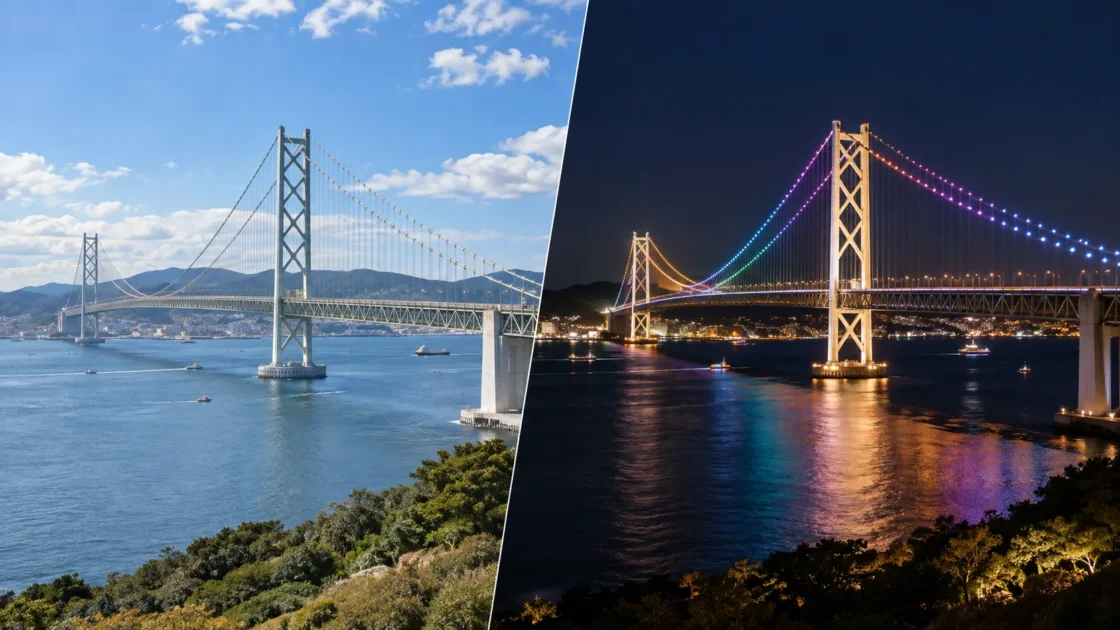
The Akashi Kaikyo Bridge becomes a changing line of color across the Akashi Strait after sunset, with different lighting programs used for ordinary weekdays, weekends and holidays, clock-based color changes, and selected special dates. Rather than staying in one color all evening, the bridge can move through pearl tones, rainbow sequences, jewel-inspired colors, and event-specific designs.
Current Illumination Schedule
Monday through Friday, performances are scheduled at 8:00 PM, 8:30 PM, 9:00 PM, 9:30 PM, 10:00 PM, 10:30 PM, and 11:00 PM. Saturday and Sunday, performances are scheduled at 8:00 PM, 8:30 PM, 9:00 PM, 9:30 PM, 10:00 PM, 10:30 PM, 11:00 PM, and 11:30 PM.
The schedule card above is the right place to use for the current operating period. The bridge operator also publishes special-date programs, so the colors shown on a particular evening can differ from the normal seasonal pattern.
How the Bridge Lighting Changes
The official illumination system uses 31 lighting patterns: 28 basic patterns plus three additional designs named Shining Lights, Aurora, and Sakura. This gives the bridge a much broader visual program than a simple on-or-off architectural light display.
On ordinary weekdays, the base pearl color changes with the season. Spring uses pearl green, summer pearl blue, autumn pearl pink, and winter pearl yellow. The regular weekend and holiday program uses a blue-green scheme instead.
There are also clock-based changes within the evening program. Rainbow sequences are used as an hourly time signal, while jewel-colored sequences mark the half hour. The jewel theme changes by month and follows birthstone-inspired colors such as garnet, aquamarine, emerald, sapphire, topaz, and turquoise.
Viewing Tip
If the bridge first appears to be holding one steady color, allow some time before leaving. The standard program includes timed transitions, so a later part of the same evening can look noticeably different.
The lighting follows the suspension cables as well as the towers, making the overall shape of the crossing easy to read from the Kobe shoreline. From a wider viewpoint, the color changes are easier to see across the span than from immediately beneath the structure.
When Special Programs Replace the Usual Colors
Selected dates have their own illumination programs. The bridge operator publishes a separate schedule for these nights, covering annual occasions, local events, commemorative dates, public campaigns, and other temporary programs.
Recurring examples include New Year lighting, the anniversary of the bridge opening, Golden Week programs, summer displays, Christmas lighting, and the New Year’s Eve program. Some of these use a themed color, while others cycle through a larger selection of the bridge’s available patterns.
That distinction matters when choosing a date specifically for photography. A weekday seasonal color seen on one visit does not mean the bridge will use the same program on the same day of the week during a special event period.
The three additional patterns listed by the operator—Shining Lights, Aurora, and Sakura—add different multi-color effects to the normal set of basic patterns. Special programs can also combine many of the available patterns during one evening.
The current schedule information was last verified on September 19, 2026.
Watching the Illumination from Maiko
The Kobe end of the bridge reaches the shoreline at Higashimaiko in Tarumi Ward. The Maiko waterfront gives a broad land-based view across the Akashi Strait, with the nearest tower, cables, central span, and the direction of Awaji Island visible together.
JR Maiko Station is directly beside the bridge area, making this one of the simpler large Kobe landmarks to reach by rail. This is useful for an evening visit because you do not need to cross the bridge simply to see the illumination from the Kobe side.
Maiko Marine Promenade provides a much closer look at the bridge structure and extends beneath part of the crossing, but it operates as a separate visitor facility with its own opening hours. Its operating hours should therefore not be treated as the illumination schedule.
For photography of the entire illuminated span, stepping farther back along the waterfront provides more space in the frame. A position directly under the bridge emphasizes the tower and structure instead, so the better location depends on whether you want the engineering details or the full lighting pattern.
The lighting is visible across a large section of the strait, and views from the Awaji Island side give the opposite perspective toward Kobe. For most visitors arriving by train in Kobe, however, the Maiko side is the more straightforward place to begin.